
5 Camera Blind Spots Every Property Manager Misses
You can have cameras on every corner of your property and still miss the moment that matters. A good camera plan isn't about the number of cameras—it's about coverage, placement, and the angles you forgot to check. Over and over, we walk properties where the hardware is solid but the footage is useless for the one incident the owner cared about.
Here are five blind spots that quietly undermine otherwise decent camera systems, and what to do about each one.
1. The Area Directly Beneath the Camera
A camera mounted high on a wall or pole gives you a great view across a space—but almost no view of what's happening right below it. Someone standing against the wall under the unit, tampering with a panel, or propping a door can be completely out of frame.
This matters most at entrances, loading areas, and equipment cabinets, where the action often happens close to the wall. The fix is usually a second camera with an overlapping field of view, or a dome placed so its footprint includes the base of the opposing wall. Think in terms of cross-coverage: every camera should have another camera watching its blind side.
2. Stairwells and Transitional Spaces
Hallways and lobbies tend to get attention. Stairwells, service corridors, and the short connectors between buildings often get skipped—and those are exactly the paths people use when they'd rather not be seen.
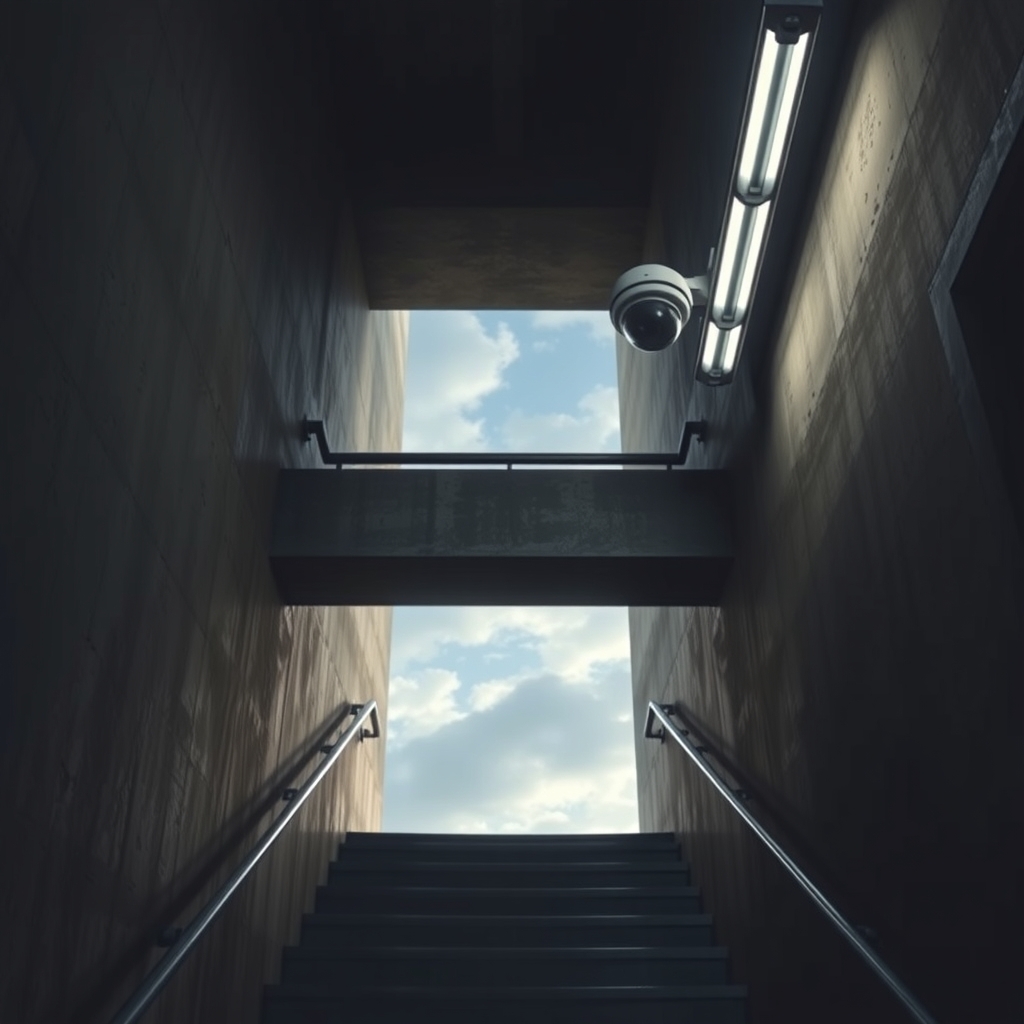
Stairwells are tricky because of their vertical layout and harsh lighting contrast. A single camera on a landing may only capture one flight. Consider:
- Cameras at both the top and bottom landings, facing the full run of stairs.
- Models with strong wide dynamic range to handle bright windows and dark corners.
- Coverage of the door at each level, not just the steps.
If someone can move between floors without ever appearing on camera, that's a gap worth closing.
3. Trash Enclosures, Loading Docks, and the Back of the Property
The front of a property usually looks sharp on camera. The back—dumpster enclosures, service entrances, and delivery areas—is where illegal dumping, break-ins, and after-hours activity actually occur. These spaces are often dim, cluttered, and far from the main run of cabling, so they get left for "later."
A camera covering the rear service area pays for itself the first time you need to identify who dumped a mattress in your enclosure or forced a back door. Pair it with good lighting or an infrared-capable camera, because these areas are frequently the darkest on the site.
4. Parking Structures and Vehicle-Level Views
Many parking cameras are aimed to capture the lane or the entrance, which is useful for traffic flow but weak for identifying people and plates. A camera mounted too high and angled too wide gives you the roof of every car and the top of every head—and little else.
To make parking footage actually usable:
- Add a dedicated camera at license-plate height and angle for entries and exits, separate from your overview cameras.
- Cover the pedestrian paths between parked cars and the elevator or stairwell door, where confrontations and theft happen.
- Watch the dark corners and support columns that create natural hiding spots.
License plate recognition only works when a camera is positioned and tuned for that single job. One overview camera cannot do both.
5. Windows, Low Roofs, and Second-Story Access Points
Camera plans tend to follow the ground floor because that's where doors are. But ground-level roofs, fire escapes, awnings, and accessible windows are common entry routes that no door-focused system will ever capture.
Walk your property and ask a simple question: if someone wanted in without using a door, where would they climb? A dumpster next to a low roofline, a wall adjacent to a second-story window, or an unlit side yard are all worth a camera. These angles are easy to miss from inside a control room and obvious from the outside.
How to Find Your Own Blind Spots
You don't need special tools to start. Pull up your live camera views and physically walk the property at the same time, noting every spot where you disappear from the screen. Then repeat the walk after dark, because lighting changes everything. Many systems that look complete at noon are nearly blind at 9 p.m.
When you review, focus on three things: coverage (is anywhere unwatched?), clarity (can you identify a face or plate, not just see motion?), and continuity (can you follow someone from the street all the way to a door without losing them?).
Closing these gaps often costs far less than a full system overhaul—sometimes it's a matter of repositioning existing cameras, adding one or two units, or improving lighting in a single area.
If you'd like a second set of eyes on your property, SmartConnect L.A. offers a free, no-pressure assessment. We'll walk your site, map your current coverage, and show you exactly where the gaps are. Call 310-893-0878 to book your free assessment.
Want this protecting your property?
Talk to a local SmartConnect L.A. specialist — no pressure, no jargon.
Get a free assessment